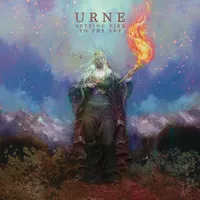
Setting Fire to the Sky

From the Ashes to the Sky: Who URNE Are
When I discovered URNE, I felt like someone who finds an old book on a hidden shelf: a band that, despite being relatively young, carries giant echoes of the metal that shaped my own formation, from progressive advances to the visceral weight that colors contemporary sludge and groove. Hailing from London, the band had already been refining their approach since the vigorous Serpent & Spirit and the emotionally charged A Feast on Sorrow. With Setting Fire to the Sky, released in January 2026, they not only make their identity explicit, but also extend a symphonic and destructive invitation to all who live metal as a vital force.
Kicking the Door Open: The Beginning of the Sonic Journey
Right from the opening track, 'Be Not Dismayed', the feeling is that of thunder announcing a storm. The brutal sound imposes itself with riffs that tear through the silence, sweeping away any lingering doubt about the band’s intention. The fluidity with which it moves between aggression and melody is one of its strengths: the roaring guitar, the interwoven lines, and the drums that guide everything with the precision of a high-speed locomotive.
Continuing with tracks like 'Weeping To The World' and 'The Spirit, Alive', the album’s best trick emerges, it is heavy and, at the same time, seductive. Riffs that recall Mastodon and Gojira are seasoned with melodies that do not get lost in the chaos, on the contrary, they ignite an inner flame that burns long after each chorus.
Weaving and Destroying: Metal in Layers
The core of Setting Fire to the Sky reaches its peak in pieces like the title track and, above all, in 'Harken The Waves', an epic of more than nine minutes that does not limit itself to being heavy, but expands like an architectural work of sound, featuring Troy Sanders of Mastodon, who stacks texture upon texture in a natural and overwhelming way.
'The Ancient Horizon' and 'Towards The Harmony Hall' sustain this vision: riffs that cast light and shadow, tempo shifts, and nuances reminiscent of the great prog explorations of modern metal. Here, no space is wasted, every note was chosen with purpose. Even when the band softens, as in the closing track 'Breathe', enriched by the presence of cellist Jo Quail, the sensation is that of a deep breath after an intense dive.
Conclusion: The Metal That Burns and Transforms
If I had to translate Setting Fire to the Sky into an image, it would be a wall in flames against a steel-colored sky at dawn: heavy, incendiary, yet full of its own light. It is a record that, to me, stands as the point where URNE ceases to be a promise and becomes an indispensable presence in the modern scene, capable of attracting both purists and those seeking new ways to feel metal.
Although not perfect at every moment, its ability to stitch together intensity with melody, brutality with nuance, places it prominently on the radar of recent releases. For those who live metal as both a visceral and cerebral experience, this album is an invitation not only to listen, but to feel.